
You keep spare fuses handy
Replacing a fuse every few weeks is not maintenance, it is a circuit telling you it is overloaded. A breaker on that circuit would trip for the same reason, but you would stop ignoring it.
If you keep a box of spare fuses on a shelf in the garage, you already know the problem. Fuse panels were built for a house with a radio and two lamps per room, not a house with a heat pump, a microwave, and a garage freezer. Gale Electric replaces fuse panels with modern breaker load centers across the Tri-Cities, pulls the permit, and gets it inspected.
Replacing a fuse every few weeks is not maintenance, it is a circuit telling you it is overloaded. A breaker on that circuit would trip for the same reason, but you would stop ignoring it.
A 30 amp fuse in a socket feeding 14 gauge wire lets the wire heat past its rating without ever blowing. This is common in older homes and it removes the only protection the circuit had.
Brown or black discoloration at the socket means the fuse has been running hot in a loose contact. Heat at that connection travels into the panel bus, and it does not improve on its own.
Washington carriers regularly ask about fuse panels at renewal, and some will not write a new policy over one. Replacement is usually the answer they are looking for, along with proof of a permitted install.
A four or six fuse panel on a 60 amp service was adequate in 1955. It cannot carry central air conditioning, an electric range, and a dryer, and there is nowhere to add a circuit for anything new.
A properly sized fuse is an effective overcurrent device. That is why they are still used in industrial gear. The problem in a house is that the protection depends on a person choosing the correct fuse in a dark garage, and there is nothing stopping anyone from screwing in a larger one to stop the nuisance. A breaker cannot be swapped that way without tools and intent, which makes the protection stay correct long after the person who installed it moved away.
The second problem is capacity. Most residential fuse panels in Kennewick and Pasco are 60 or 100 amp with four to eight circuits, and they have no room for arc fault or ground fault protection, no separate equipment ground bar, and often no equipment ground in the branch circuits at all. Replacing the panel is the moment those things get corrected, which is why the work is usually worth more than the panel itself costs.
Home inspectors in the Tri-Cities flag fuse panels as a matter of routine, and buyers price that flag into their offer. Insurance carriers treat them the same way, with some declining coverage and others requiring replacement within a set window after closing. None of that is a judgment about your house. It reflects the statistical record of oversized fuses, tampered sockets, and forty year old branch circuits sitting behind an obsolete panel.
Replacing the panel before you list removes the negotiating point entirely. You get a permitted, inspected installation with documentation, and the buyer gets a panel that will not come up in their financing or insurance conversation. Doing it while you still live there also means you get the benefit of the breaker spaces, which is the part homeowners tell Kyle they wish they had done five years earlier instead of three weeks before listing.
The fuse panel comes out and a breaker load center goes in at the same location, sized to the existing service or to a larger one if the load calculation supports it. Each existing branch circuit gets landed on its own breaker with the conductor cut back to clean copper, stripped to the correct length, and torqued to the manufacturer specification. Circuits that currently share a fuse get separated where the wiring allows, which is often where the nuisance blowing was coming from.
Older panels frequently hide surprises: cloth insulated conductors that crumble when moved, splices made inside the panel without a box, and neutrals bonded in the wrong place. Kyle prices the panel work up front and tells you what a bad conductor repair would add before he touches it, rather than calling from your garage with a new number. If a circuit is beyond repair, you hear that with the reason and the options attached.
Most fuse panel homes were wired with two conductors and no equipment ground. That means every three prong receptacle in the house that looks grounded may not be. It also means a fault in an appliance has no low resistance path back to the panel, so the fuse or breaker may never open while the appliance chassis sits energized. That condition does not announce itself until somebody touches the wrong thing on a wet day.
Panel replacement includes rebuilding the grounding electrode system: driven rods, a proper grounding electrode conductor, and bonding to the metal water and gas piping per NEC Article 250. Ungrounded branch circuits get addressed with GFCI protection where NEC 406.4(D) permits it, and the receptacles get labeled accordingly. Full rewiring is the complete fix, and Kyle will tell you plainly which circuits need it and which are safe to leave alone.
Kyle opens the fuse panel, checks fuse sizing against the wire gauge, looks for heat damage, and runs a load calculation. The estimate covers the panel, the grounding, and anything the inspection will require.
We file the electrical permit with L&I or the City of Richland and set the utility disconnect with Benton PUD, Franklin PUD, or the Richland utility for a window that fits your household.
The fuse panel comes out, a breaker load center goes in, circuits are separated and landed, and a code compliant grounding electrode system is installed with water and gas bonding.
The inspector reviews the work before the cover is closed, then Kyle labels the directory by room and use and shows you how the new panel is laid out.
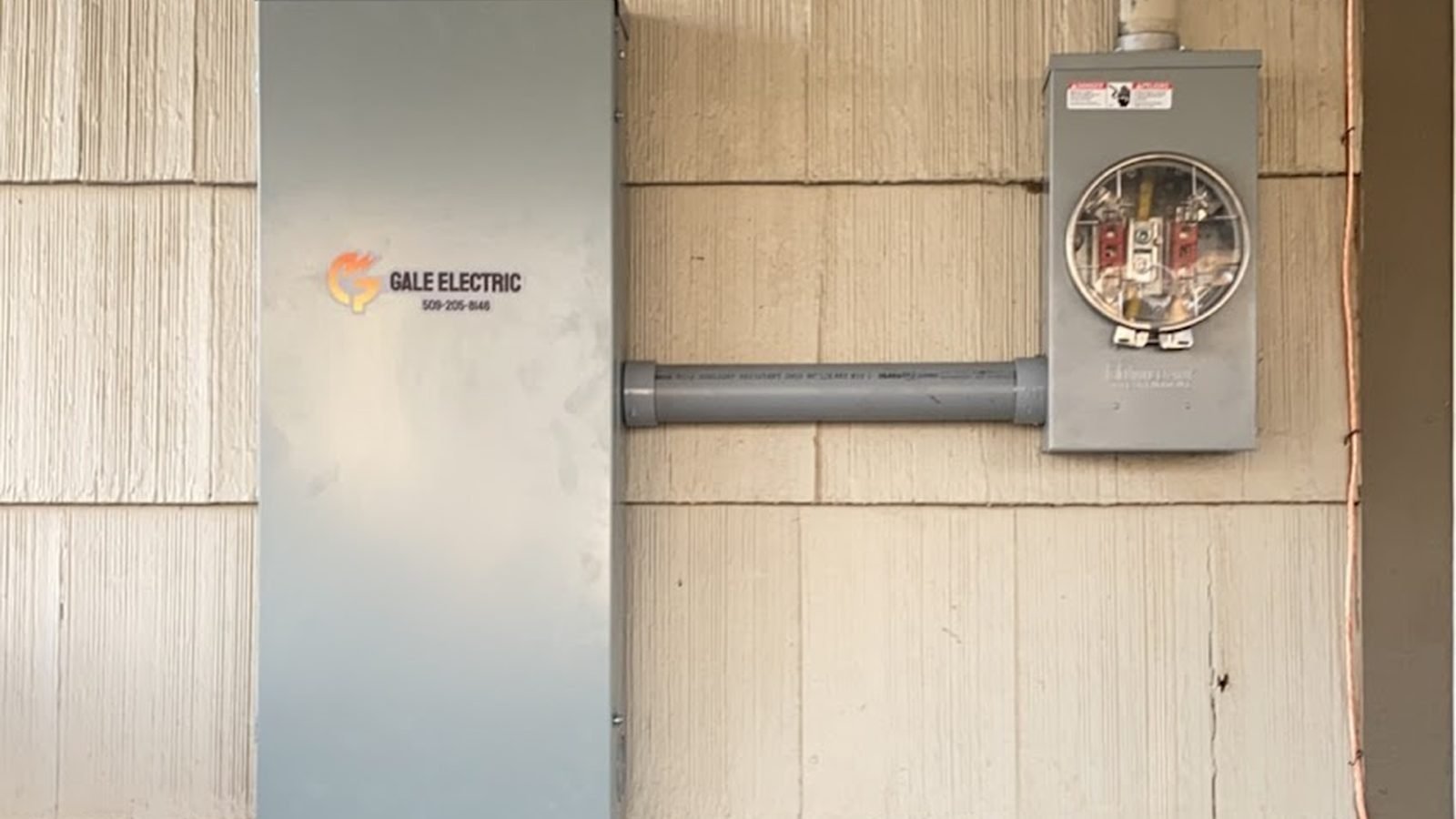
Burning smell, rust, or a recalled panel brand? Gale Electric replaces failing residential panels in Kennewick,
See detailsOut of breaker space for a heat pump, shop, or EV charger? Gale Electric upgrades residential panels across the
See detailsOld wiring, no grounds, cloth insulation? Gale Electric rewires homes in Kennewick, Richland, and Pasco with min
See detailsFree estimates across the Tri-Cities. Call Kyle and the crew, or send the details and we will come look.
We use cookies for basic analytics and to see which ads bring people here. No personal data is sold. Privacy policy