
You are buying an older home
Anything built before the mid 1970s deserves a look at the panel and the branch wiring before closing, not after.
An electrical inspection is a licensed electrician going through the service, the panel, the grounding, and a sample of devices and connections, then writing down what is safe, what is worn out, and what is genuinely dangerous. It is the step people take before buying a house, after an insurance letter, or when something in the panel has started to feel off.
Anything built before the mid 1970s deserves a look at the panel and the branch wiring before closing, not after.
Carriers ask about panel brand, service size, and wiring type. A written report from an electrician answers them properly.
Repeat tripping is the system telling you something. Finding out why is cheaper than replacing what fails next.
Heat at a breaker, an outlet, or a switch plate means a loose or failing connection. That is a same-week problem.
Unpermitted additions, garage circuits, and hot tub feeds are the most common places we find real hazards.
We start outside at the service, looking at the drop or lateral, the meter base, and the mast for corrosion, loose fittings, or damage from wind. Inside the panel we check the main rating, the condition of the bus, breaker sizing against the conductor sizes they protect, double-tapped breakers, and whether the neutrals and grounds are separated correctly. Grounding and bonding get their own pass, following NEC Article 250, because a missing ground electrode or an unbonded water line is invisible until it matters.
Then the branch side. We sample receptacles and switches across the house, test every GFCI and AFCI device, verify protection is present where NEC 210.8 and 210.12 call for it, and look for ungrounded three-prong outlets, reversed polarity, and open grounds. We open a representative set of boxes, check junction boxes in the attic and crawlspace, and look at the wiring methods feeding the garage, the well, and any outbuilding. Anything hidden behind finished walls gets noted as unverified rather than guessed at.
Richland has a large stock of Hanford-era houses from the 1940s and 1950s, and many still carry pieces of their original systems. That means 60 or 100 amp services that were adequate for a wringer washer and three lamps, panels that ran out of spaces two remodels ago, ungrounded two-wire branch circuits, and cloth-jacketed conductors that turn brittle where they pass near a heat source. None of it is automatically an emergency. All of it changes what the house can safely carry.
Homes built from roughly 1965 to 1973 are the ones to check for solid aluminum branch wiring, which needs approved connectors at every device rather than a wire nut and hope. We also flag panel brands with documented breaker failure histories, including Federal Pacific Stab-Lok, Zinsco, and Challenger. Newer neighborhoods in West Richland and south Kennewick have different problems, usually production-build shortcuts and a garage or shop circuit somebody added later without a permit.
A general home inspector is a generalist and their report reflects that. It usually reads recommend evaluation by a licensed electrician, which is where we come in. On a purchase, an electrical inspection turns that vague line into a specific list with costs attached, which is something you can negotiate with. It also tells you whether the thing that looks scary is a fifty dollar fix or the front end of a rewire.
On the insurance side, carriers increasingly ask homeowners to document the panel brand, service size, and wiring type before they will write or renew a policy. A written report from a licensed contractor, on letterhead, with the license number on it, is what satisfies them. If you are selling, doing this before you list means you set the terms instead of reacting to a buyer's inspector three days before closing.
You get a written report with photographs, organized by priority rather than by room. Fix now covers anything that can start a fire or shock somebody, like a failing connection, a missing ground, or an overloaded conductor. Fix soon covers code deficiencies and worn equipment that are not immediate hazards. Monitor covers the things that are simply old and worth watching. Every item includes what it is, where it is, and why it matters in plain words.
Repairs are quoted separately and there is no obligation to have us do any of them. Kyle would rather hand you an honest list than manufacture a reason to sell a panel. If the report says your 1954 panel has ten good years left in it, that is what it will say. If it says the aluminum branch circuits need connectors at every device before you put a bigger air conditioner on that service, it will say that too, with the reasoning attached.
Call and tell us what prompted it, a purchase, an insurance letter, or something you noticed. That shapes where we spend the time.
Service, meter, panel, grounding, then a sampled walk of devices, boxes, and any garage, shop, or outbuilding circuits.
GFCI and AFCI testing, polarity and ground verification, connection checks, with photographs of anything that goes in the report.
We go through the report with you in person or on the phone, sorted by priority, and answer questions before you decide anything.
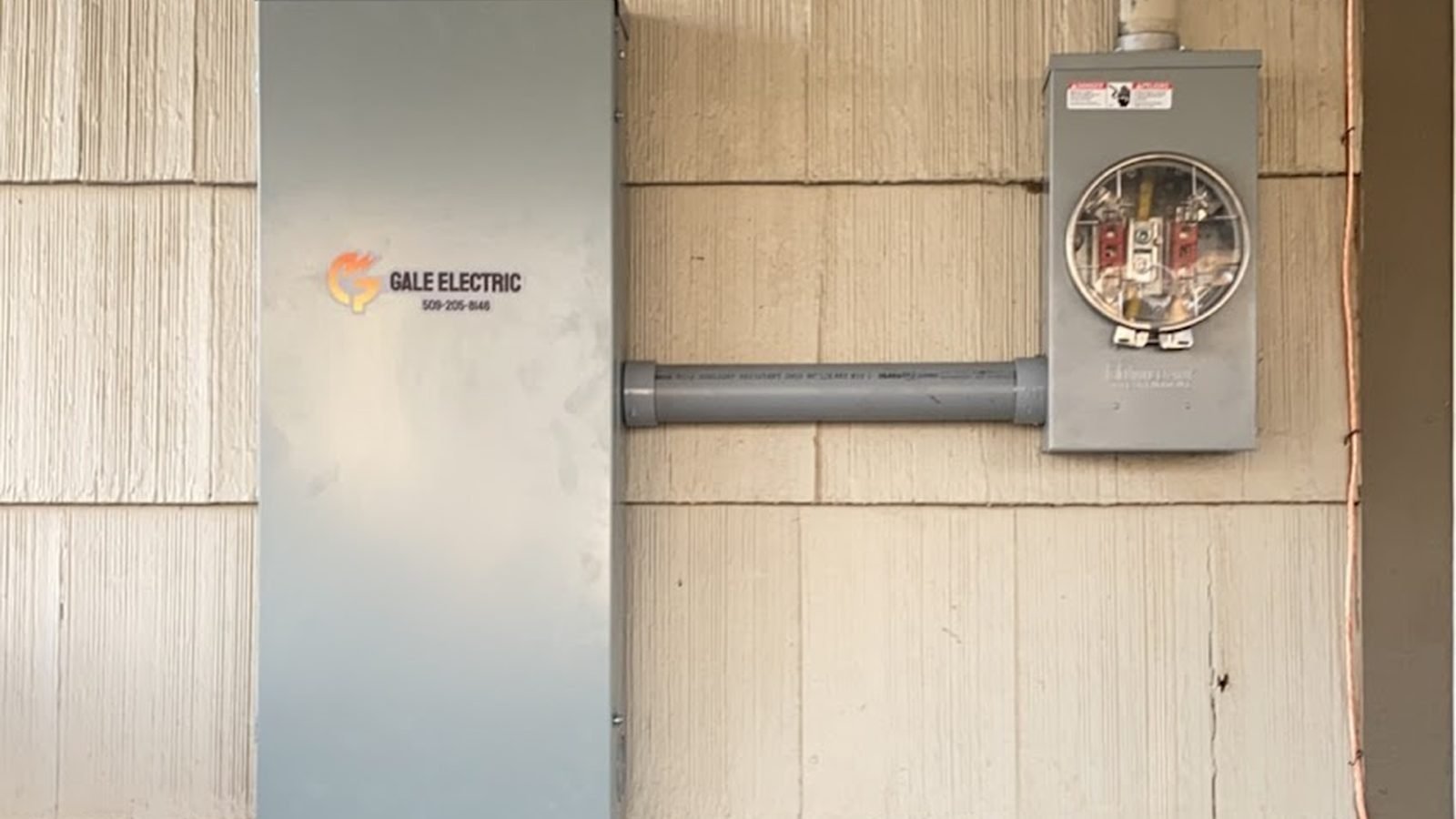
Out of breaker space for a heat pump, shop, or EV charger? Gale Electric upgrades residential panels across the
See detailsElectrical troubleshooting in Kennewick, Richland, and Pasco. Tripping breakers, dead outlets, flickering lights
See detailsWarm outlets or flickering lights on 1960s aluminum branch wiring? Gale Electric repairs and pigtails it across
See detailsFree estimates across the Tri-Cities. Call Kyle and the crew, or send the details and we will come look.
We use cookies for basic analytics and to see which ads bring people here. No personal data is sold. Privacy policy